Some thoughts.
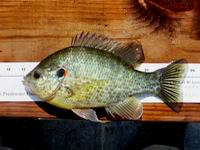
RES reproduce at 1/2 or less of the rate of BG
As far as I know (and I looked for Dave W.'s RES vs PS article in PB) there is no indication of anyone observing RES stunting and that was set out in his article.
Dave thinks the RES /SMB combo can be very good . I do also.
That is not exactly what you described ie male BG and HSB.
BG and RES cross and backcross. Crosses are 98% +- male.
I don't think that will matter as the traits set out below indicate the cross if it occurs will lower the reproductive rate . In crossing the pair have fewer offspring than either BG or RES couples. Thank you Bill C. for pointing that out.
With SMB and HSB you may be forage short. Think about starting a population of GShiners from your other pond. Adds a different niche (high in the water column and eats differently ) to the pond which should help HSB and SMB. Craws are also a good idea as RES and SMB like crustations . FH to start.
SMB reproduction is a real trick. Bill has posted on it . If I find anything I will pass it on.
Points by others.
Bill on BG X RES crosses:
I noted that the numbers of hybrids produced were pretty low compared to the reproductive potential of both species. Since
female RES were used in both studies, fecundity would be expectedly lower than if similar sized female bluegills were used. Carlander reported RES females at 8"+ produced a mean number of 20,000 - 26000 eggs per fish whereas bgill females produced a mean of 58,000 eggs (38k-81K). The Krumholtz paper reported a harvest of 16000 hybrids from 8 pairings vs Ricker's paper reported 46,000 hybrids from 10-15 pairings.
Childers Wheat and Whitt :
Gametes stripped from male red-ear sunfish R and female bluegills B were used in the laboratory
to produce RB F1, hybrids which were grown to maturity in a farm pond (CHILDERS).
Six mature male F1, hybrids were placed in each of two east-central Illinois ponds containing no
other fish. Female bluegills were added to one pond, and female red-ear sunfish to the other.
Successful reproduction occurred in both ponds, and the backcross progeny were sampled by
seining when they were 4-5 months old.
Ricker :
The F1 hybrids included only 2 percent
females. They have spawned successfully, however, and in two ponds
produced F1 broods in what seem to be fairly good numbers per female involved.
The F2 brood has been exclusively male, but only 13 have been
examined so far.
Check your mail.


.gif)