|
Forums36
Topics42,115
Posts571,702
Members19,116
| |
Most Online45,564
Yesterday at 03:05 AM
|
|
|
|
Joined: Feb 2009
Posts: 55
Lunker
|
|
Lunker
Joined: Feb 2009
Posts: 55 |
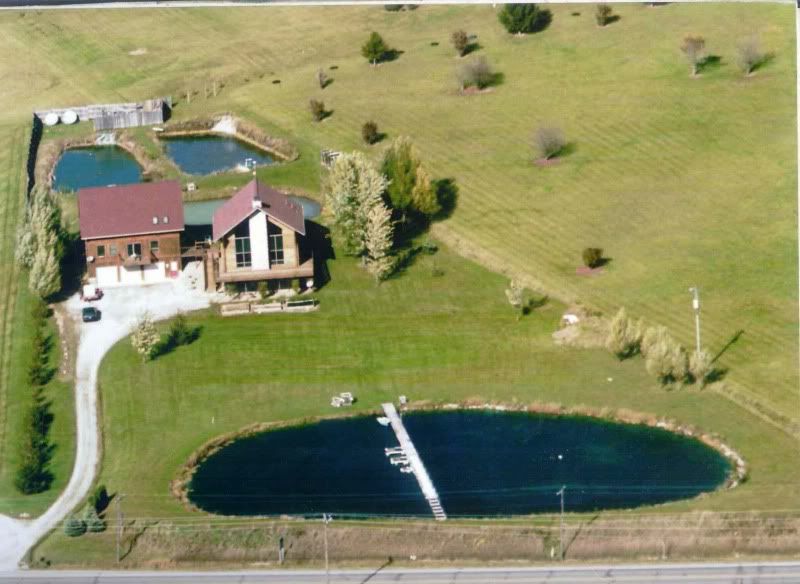
Hi I am brand new to this site first post this is a great site though!!! I have a 1 acre pond that I will be stocking from scratch, I am located in North Eastern Indiana, the deepest spot in the pond runs 14 ft the pond averages 7-9 ft deep Here is what I would like to do I want Big Trophy Blue gills, I would also like to have huge perch, along with this I would like to have Hybrid Stripped bass, and Walleyes. Do you think this could work? Also I am planning on feeding the bluegill and buying pellat trained perch and Hybrid bass, I will also be feeding minnows on a regular basis and was thinking that the walleyes would also help control the population of Perch, I would also be game for adding structure to the pond. Any suggestions would be greatly appreciated. Also what kind of numbers of these fish should I stock?
Thanks Jason
Last edited by Bill Cody; 02/21/09 09:00 PM. Reason: Clarified Title
|
|
|
|
|
Joined: Feb 2007
Posts: 1,255
Lunker
|
|
Lunker
Joined: Feb 2007
Posts: 1,255 |
Howdy, Jason, and welcome. Interesting combination, I would expect comment from our more northern experts, and will be especially interested in those from Bill "It's the forage, stupid!" Cody. The hybrids will be easy, they'll come pellet trained and will likely stay so. It'll be the perch, BG, and walleye that will require the management time and expertise.
|
|
|
|
|
Joined: Apr 2002
Posts: 16,001 Likes: 1499
Moderator
Ambassador
Field Correspondent Lunker
|
|
Moderator
Ambassador
Field Correspondent Lunker
Joined: Apr 2002
Posts: 16,001 Likes: 1499 |
Several things first.
1. Ideally the pond should receive bottom aeration. Your planned fish will do better with it.
2. Do you want BG to be reproducing or are you content with just a set number of trophies present that would function as put and take fish? HOw big is a trophy bluegill?
3. Same question as No 2 but substitute perch for BG. HOw big is a huge perch?
4. Walleye and HSB will readily survive in your locale. Although No 1. improves the chances of success.
5. Just what do you mean by "feeding minnows on a regular basis"? What species? HOw many and how often? HOw big is your wallet? Keeping walleye and non pellet eating large perch well fed coudl involve adding 40-80 lbs of forage fish per year which is easily how much could be produced in a small pond without predators.
Last edited by Bill Cody; 02/17/09 08:36 PM.
aka Pond Doctor & Dr. Perca Read Pond Boss Magazine -
America's Journal of Pond Management
|
|
|
|
|
Joined: Jan 2009
Posts: 10,458 Likes: 3
Ambassador
Field Correspondent
Hall of Fame Lunker
|
|
Ambassador
Field Correspondent
Hall of Fame Lunker
Joined: Jan 2009
Posts: 10,458 Likes: 3 |
spc, welcome to the forum! Once you answer the questions Bill asked, we'll do our best to get you headed in the right direction... What you are seeking is most likely possible, but will take a lot of management on your part.
|
|
|
|
|
Joined: Jul 2006
Posts: 7,615 Likes: 7
Ambassador
Field Correspondent Lunker
|
|
Ambassador
Field Correspondent Lunker
Joined: Jul 2006
Posts: 7,615 Likes: 7 |
Hello Spc and welcome to Pond Boss. What Bill is telling you is that having any species of fish of "trophy" size requires significant management. No one is trying to discourage your goals, just trying to give you the facts.
We're glad you found Pond Boss, thanks for joining in.
JHAP
~~~~~~~~~~
"My mind is a raging torrent, flooded with rivulets of thought cascading into a waterfall of creative alternatives."
...Hedley Lamarr (that's Hedley not Hedy)
|
|
|
|
|
Joined: Feb 2009
Posts: 55
Lunker
|
|
Lunker
Joined: Feb 2009
Posts: 55 |
Trophy bluegill to me would be 10 plus inches the big round ones, Trophy perch to me would be 12 plus inches, I figure I would let the Bluegill reproduce for 2 reasons number one ffed the Hybrid stripped bass and number 2 put some fish in my freezer, Although I do not want tons of gills in the pond, As for the perch I figure I would also let them reproduce haveing the walleye keep their populations in check and put some in my freezer.
As far as feeding them minnows I was planning on feeding fathead minnows and shinners my plan was to feed 20 pounds of fatheads 4-5 times a year and 5 lbs of shinners 5 times a year, I will also be feeding my bluegills, hybrid strippers, and they tell me the perch also will be pellet trained so all 3 of them pellets,
How would the areator be benifical to the fish I no nothing about them , what kind, where do you get and how much are these?
Thanks Jason
|
|
|
|
|
Joined: Feb 2009
Posts: 55
Lunker
|
|
Lunker
Joined: Feb 2009
Posts: 55 |
I also have a decent natural supply of crawfish in the pond
|
|
|
|
|
Joined: Oct 2005
Posts: 1,285 Likes: 1
Lunker
|
|
Lunker
Joined: Oct 2005
Posts: 1,285 Likes: 1 |
$1000 worth of forage per year plus pellets and aeration costs, whew, I thought only Texans did that! That much forage does make a strong case for a forage pond (was that a hint Bill?)
Other's much more knowledgeable than I will surely chime in. I've heard that walleye will do well on BG for forage but can't confirm the source and I'm curious if WE would be effective enough at controlling medium sized BG to help the large BG reach trophy status. WE grow pretty slow so stocking larger ones may be needed to keep those 2nd and 3rd year BG offspring in check. My guess is that HSB will be pretty well tuned into the pellets/shiners and fatheads and not so much BG and their mouths aren't big enough to put much pressure on medium BG. I think a 12" YP or 10" BG are very reasonable goals within a few years, especially in a new pond stocking situation.
 "The greatest enemy of knowledge is not ignorance, it is the illusion of knowledge." Stephen W. Hawking
|
|
|
|
|
Joined: Feb 2009
Posts: 55
Lunker
|
|
Lunker
Joined: Feb 2009
Posts: 55 |
Ryan, I am going to be pretty fortunate on the price of buying the minnows I can dump all the minnows I posted above for 500.00, My dad buys them wholesale!!! So that helps out!!!! I figure the hsb will help control small bluegill not so much the medium ones, and not sure on the walleye eating the BG, I was actually thinking of starting my bluegill off large like the 8 plus inchers, to give them a jump start.
|
|
|
|
|
Joined: May 2004
Posts: 14,678 Likes: 509
Moderator Lunker
|
|
Moderator Lunker
Joined: May 2004
Posts: 14,678 Likes: 509 |
spc, try reading through the archive thread Aeration Simplified and it's links.
"Live like you'll die tomorrow, but manage your grass like you'll live forever." -S. M. Stirling ![[Linked Image from i.pinimg.com]](https://i.pinimg.com/736x/ed/b5/e7/edb5e7f935843b996cf52be593c9ebd2--smoothie-smooth-collie.jpg)
|
|
|
|
|
Joined: Feb 2009
Posts: 55
Lunker
|
|
Lunker
Joined: Feb 2009
Posts: 55 |
so does anybody think this is a doable situation with the info i have provided?
|
|
|
|
|
Joined: Jan 2009
Posts: 10,458 Likes: 3
Ambassador
Field Correspondent
Hall of Fame Lunker
|
|
Ambassador
Field Correspondent
Hall of Fame Lunker
Joined: Jan 2009
Posts: 10,458 Likes: 3 |
I think the odds of consistently growing 10" BG, 12" YP, nice sized HSB and a few walleye is very possible in a 1 acre pond. You really need to consider the aeration and I hope you read all the prior threads on that topic so you are off to a good start. The BG, YP and HSB are all pellet eaters if trained, so you can certainly increase biomass, growth rates and up the odds that you will grow those fish to the sizes you want.
Some issues you will face... Keep your numbers of BG you initially stock low. YP, HSB and WE are not effective BG predators. So you will most likely face a challenge in keeping their numbers in check. LMB have large mouths and are the most effective as controlling BG numbers. So you may want to consider adding them to the mix to help keep the BG numbers under control. If you don't, definitely keep the original number of BG stocked low. I would I also make sure you have established a very large quantity of FHM and GSH in your pond before stocking the HSB and particularly the WE. WE are hungry and can often struggle to maintain weights in smaller ponds such as yours, but it is not impossible.
My stocking recommendations are this:
This spring, stock FHM and GSH in the largest amount you can afford. Allow them to reproduce all summer.
This fall, stock the YP and BG. I would stock 200 5-7" YP and 200 3-5" BG. I realize these are smaller numbers than normal, but you are not really using the BG to feed LMB. BG will not be hammered nearly as hard by the HSB and WE as they would by LMB. I am extremely concerned about the BG overpopulating without LMB predation.
Your YP and BG should spawn the following spring with the BG continuing to spawn into the summer. This will establish a very large pool of 1/2" to 2" BG in the pond come fall.
As the weather cools next fall, you can then add the WE and HSB. The WE and HSB will not reproduce in your pond so it will be simply a put and take fishery. I would recommend 50 HSB and 25 WE. This first stocking you can get away with smaller sizes. Say 3-5" size but if you can afford it, get a larger size for both species, as this will get them off to a better start and allow them to feed on some of those larger 2" and 3" BG and YP.
The following fall, you can consider adding another batch up HSB and WE. Perhaps stocking HSB one fall, then WE the next and so on...
Keep an eye on your BG. You will have to most likely assist the WE and HSB by removing many middle sized BG from your pond to increase growth rates to allow BG to reach that 10". Feeding them will certainly help, but will also increase their fecundity as well. If things really get out of control, you can always consider adding LMB at a later time to help get your BG population back under control...
Last but not least, you are going to have to supplementally stock FHM and GSH to give the WE extra forage. The WE will eat a good number of YP and a few BG, but I doubt that would be enough to keep them fat and growing. Also make sure you keep the pond fairly open and free of vegetation and most cover. This will allow the HSB to be more efficient predators on the YP and BG.
This is just MHO though!
|
|
|
|
|
Joined: Feb 2007
Posts: 1,255
Lunker
|
|
Lunker
Joined: Feb 2007
Posts: 1,255 |
I would agree with everything C--3 has written above. From everything I've read on the forum, your goals are obtainable-but you are going to have to manage the heck out of the pond to get to them, and manage even harder to keep them once there. The BG especially will overwhelm your predators if not continually pounded. Are you sure you want to take out hundreds-even thousands-of 4-8" BG every year, to get to your goal of trophy BG? The YP will also have to be closely watched, though a good population of walleye should be able to control them....you may have to do quite a bit of supplemental stocking in the future, however.
I would go easy on the HSB; they'll grow like pigs, feed extremely aggressively on pellets, and probably won't be expecially effective in filling a unique predatory niche in your pond-their mouths stay pretty small even when in the 5-6# range. They're fun to catch, but they'll outcompete your perch and BG for the pellets.
If you're willing to put in the effort, it sounds like a really fun project. You could wind up with a whole lot of stunted perch and sunfish, however, if you let the pond get away from you.
|
|
|
|
|
Joined: Feb 2009
Posts: 55
Lunker
|
|
Lunker
Joined: Feb 2009
Posts: 55 |
Thanks for your comments guy's this really helps me out, please keep them comeing!!!! So you think I should add how many LMB to help controll BG? I was hopeing the HSB would help control the bg when they were in the 1/2 to 2.5 inch range. I am bery excited to get this project started, I have always wanted big gills and perch in a pond, Along with the walleye and the HSB. So what would you reccommend for areation for the pond? I have read some on this, Although I don't think in laymonds terms I have grasped it yet, but what I am getting is it will circulate the water colum while adding oxegen, but I thought their would already be plenty of oxegen in the pond with out it, so I guess I really want to know the huge benift.
|
|
|
|
|
Joined: Apr 2002
Posts: 16,001 Likes: 1499
Moderator
Ambassador
Field Correspondent Lunker
|
|
Moderator
Ambassador
Field Correspondent Lunker
Joined: Apr 2002
Posts: 16,001 Likes: 1499 |
An answer to your PM is use rotenone to eradicate all existing fish. You or your designee will need an aquatic pesticide license to purchase rotenone. If you are going to be eating fish from the pond, I strongly suggest that you do not let anyone talk you into using chlorine to kill it which will in the natural aquatic environment form trihalomethanes a persistant, bioaccumulative, fat soluable toxin in water bodies. Emulsified aquaeous rotenone (Prenfish or similar) readily decomposes into benign compounds.
Fish
CJBS has provided a possible stocking plan that could work. Now that I know what you goals are for BG (10") and YP (12"), I can better provide some pertinent advice or at least opinions.
IMO you are doing a combination that is goes against the natural habits of several of your fish species and your stated plans for management and your goals.
I would not put reproducing BG in a pond with WE, and HSB- YP (both pellet fed) with supplimental additions of minnows/shiners and expect them (WE and or YP)to even come close to controlling BG numbers. The only way I would use BG in that stocking plan is to either use male only BG or include LMB or implement a rigorous annual BG removal with traps and seines (a lot of work you would likely tire of and may not be affective at). IF you include LMB then do not expect good growth of WE or YP. But BG will do good and WE-YP just marginal. With LMB abundant enough to control BG, YP recruitment will suffer and survial of any restocked WE will suffer dramatically. Even more dramatically than when just adult WE are the major predators.
I have never seen WE effectively control BG in a pond when YP minnows and shiners are also present. As CJBS says it can work but expect "You will have to most likely assist the WE and HSB by removing many middle sized BG from your pond". Others may disagree. I would like so see someone near me try the combination you propose and prove me wrong so I can visit, sample the pond and that way I learn.
Do not count on HSB to eat very many BG when HSB are offered pellets. Without regular pellet feedings your HSB will not come close to their potential. I would dearly like to see a food habits study of regularly pellet fed HSB when combined with BG.
However what you propose to stock is VERY feasable IF you stock just or only male BG into your fish combination. No reproducing BG. Those BG stocked grow great. Readily feed on pellets. Every BG caught is a big one. Easy to manage. Main drawback is no natural recruitment which you really don't need and want. The other fish species will do fine. I have seen that plan work very effectively. To learn how to stock and manage only male BG you should do appropriate reseach here (search feature) and get and read the articles about Behemoth Bluegills in the 3 back issues of Pond Boss mag where the concept is thourghly described (Mar-Apr, May-Jun, Jul-Aug 2006).
In a one acre pond the YP, HSB, WE and few harvested BG per yr will provide plenty of fish (close to 80-100lbs) one family can eat per year providing you follow your stated plans.
Bottom Aeration will allow you to better achieve the above goals. New ponds can usually fairly easily get by without aeration. But it is the long term pond and fishery (12-20yrs) that I am thinking about. Without proper or adequate aeration water quality will prematurely decline, less fish biomass will be grown per year, oragnic muck will accumulate faster than normal, chances of summer fish kill increase due to artificially enriched conditions (supplimental natural & artificial feedings), YP ad WE will not be provided adequate cool water refuge areas in the hottest parts of the summer, and their overall condition will not be as good compared to having proper bottom aeration. My experience with WE and YP and in your climate zone one does not need to run propely sized bottom aerators 24/7. Run the aerator to just enough keep the pond circulated, the bottom oxygenated and a slighly cooler water zone at the bottom.
Do some more reading and homework then come back with more questions.
Last edited by Bill Cody; 02/19/09 08:45 PM.
aka Pond Doctor & Dr. Perca Read Pond Boss Magazine -
America's Journal of Pond Management
|
|
|
|
|
Joined: Apr 2002
Posts: 16,001 Likes: 1499
Moderator
Ambassador
Field Correspondent Lunker
|
|
Moderator
Ambassador
Field Correspondent Lunker
Joined: Apr 2002
Posts: 16,001 Likes: 1499 |
spc - Generally and almost always your pond does have PLENTY of dissolved oxygen(DO), but during the main part of the summer that DO is confined ONLY to the upper 6'-7' in a typical one acre pond in the Midwest. Water below (6'-7') that is devoid of DO esp after early to mid June. The separating layer is called a thermocline, maybe you have heard of it. This concept is called stratification. Rarely, exceptions do occur and numberous things contribute to stratificaion and destratification throught the summer.
Last edited by Bill Cody; 02/19/09 08:58 PM.
aka Pond Doctor & Dr. Perca Read Pond Boss Magazine -
America's Journal of Pond Management
|
|
|
|
|
Joined: Feb 2009
Posts: 55
Lunker
|
|
Lunker
Joined: Feb 2009
Posts: 55 |
Thanks Bill, You have answered a bunch of my questions, I appreciate this. I belive you answered my BG question I will go with male only on this forsure now, the YP should be ok reproduceing though right? So what kind of numbers would you stock on the yp, hsb, we? Also I will leave the Largemouth bass out.
I will be back with more questions thanks again
JAson
|
|
|
|
|
Joined: Aug 2002
Posts: 20,043 Likes: 1
Hall of Fame  Lunker
|
|
Hall of Fame Lunker
Joined: Aug 2002
Posts: 20,043 Likes: 1 |
SPC, As Bill Cody is trying to tell you here are some things you need to do if you want to achieve your goals: 1.) In a 1 acre fairly deep pond where you want good size deeper water fish like yellow perch or walleye you need some aeration (bottom diffusion) to mix the water column to allow the fish to use the entire water column later in the summer when dissolved oxygen levels normally become depleted. It's not that expensive and you don't need to run it 24/7. Ponds are a whole different ballgame than lakes. The deeper water without aeration becomes a dead zone oxygen wize later in the summer in ponds. If your perch and walleye have to come up to warmer less optimum temps due to this, they won't feed as well or grow as well as they could. In fact your larger perch will get stressed out by too warm of temps and you will lose a few. Been there done that. I would assume the same with walleyes but I don't know for sure as I've never attempted to raise the. 2.) If you have a feed trained species like hybrid striped bass, bluegills, or yellow it is much more cost effective to feed them pellets regardless if you get minnows at wholesale cost. It takes 10 lbs. of minnows to produce 1 lb. of fish. It only takes 2 lbs. of pellet feed to produce 1 lb. of fish. Since you only have an acre pond with the capacity to only produce a maximum of 300 lbs. of fish per acre doesn't it make more sense to produce more pounds per acre with feed and do it getting a bigger bang for your buck? 3.) Walleye are fish eating machines and rarely do they come pellet trained. A one acre pond can't sustain very many on natural forage. If you plant them, plant just enough to help keep your perch production in check. Bill Cody uses Sauger. 4.) If you're really serious about producing large yellow perch and massive bluegills listen to Bill Cody and Dr. Bruce Condello. They're the experts on this and have written numerous articles on it in our Pond Boss magazine. Bruce has taken it a step further with bluegills. Not only has he grown them to 2 lbs. plus he had been selectively breeding them for faster growth. I have some in my ponds. Being pellet fed they look like they are on steroids even a couple inches long. Here's a pic of some perch from Bill Cody's (aka Dr. Perca) 1 acre pond recently (his is brother posing with the fish). Believe it or not Bill uses a slot limit and releases the largest fish! These are not the largest perch in his pond! Bill also puts tree branchlets in the waters edge for the perch to string their eggs on in the spring. He then removes and destroys the eggs. Even then enough are missed to keep the perch going. They are very prolific breeders. Too many and you nothing but runts! And not only the sauger but the larger yellow perch help control the perch numbers too. Sometimes Bill adds female only feed trained fish that he gets from an Ohio supplier to augment the population if need be.  Here's Dr. Condello with one of his bluegills:  And btw i wouldn't count on your hybrid striped bass to keep your bluegill numbers in check. They are more pelagic (like to roam open water) and will miss a lot of the gills. Bill puts bluegills in a couple of cages and feeds them with pellets until they become large enough to sex. He then releases only the males. The males get the largest and this precludes your pond being over run with small gills and only below average growth. Edit: Sorry Bill I spent so much time on this post I didn't see your new post. Sorry for rambling. SPC, Just listen to Bill. He's the master. You can't go wrong listening to his advice as it comes from experience and he has a good science base. Postscript - Actually the main predator in Cody's pond are saugeye a hybrid of walleye and sauger. After living with and observing them for 7 yesrs, in many respects they use or serve the same niche and habits as WE in ponds. In fact, Bill thinks WE are better in ponds than saugeye. After several years of well fed pond life, all Cody's BG are similar sized to what Dr Bruce Condello is showing in the above photo.
Last edited by Bill Cody; 02/20/09 02:54 PM.
If pigs could fly bacon would be harder to come by and there would be a lot of damaged trees.
|
|
|
|
|
Joined: Feb 2009
Posts: 55
Lunker
|
|
Lunker
Joined: Feb 2009
Posts: 55 |
So what kind of numbers of thes fish should i stock?
|
|
|
|
|
Joined: Feb 2009
Posts: 55
Lunker
|
|
Lunker
Joined: Feb 2009
Posts: 55 |
Also is their any recommendations for adding structre to my pond?
|
|
|
|
|
Joined: Jan 2009
Posts: 10,458 Likes: 3
Ambassador
Field Correspondent
Hall of Fame Lunker
|
|
Ambassador
Field Correspondent
Hall of Fame Lunker
Joined: Jan 2009
Posts: 10,458 Likes: 3 |
Do a search on the forum... There are several excellent threads on different kinds of structure and how to build them.
|
|
|
|
|
Joined: May 2004
Posts: 14,678 Likes: 509
Moderator Lunker
|
|
Moderator Lunker
Joined: May 2004
Posts: 14,678 Likes: 509 |
"Live like you'll die tomorrow, but manage your grass like you'll live forever." -S. M. Stirling
|
|
|
|
|
Joined: Apr 2002
Posts: 16,001 Likes: 1499
Moderator
Ambassador
Field Correspondent Lunker
|
|
Moderator
Ambassador
Field Correspondent Lunker
Joined: Apr 2002
Posts: 16,001 Likes: 1499 |
I'm working on a credible numbers plan for stocking based on experiences in NW Ohio. This is not a simple or easy task considering the possible variables involved and I don't know anything the pond site. Give me another day or two. Also note that I enhanced the topic title to include location - Northeast Indiana. Many in other areas of the country will not be interested in the stocking combination.
aka Pond Doctor & Dr. Perca Read Pond Boss Magazine -
America's Journal of Pond Management
|
|
|
|
|
Joined: Feb 2009
Posts: 55
Lunker
|
|
Lunker
Joined: Feb 2009
Posts: 55 |
Thanks Bill, I will look forward to your numbers!!!
|
|
|
|
|
Joined: Feb 2009
Posts: 55
Lunker
|
|
Lunker
Joined: Feb 2009
Posts: 55 |
Hey where can I find the articles on the Behemoth Bluegills, that Bill suggested I read are they on this site?
|
|
|
Moderated by Bill Cody, Bruce Condello, catmandoo, Chris Steelman, Dave Davidson1, esshup, ewest, FireIsHot, Omaha, Sunil, teehjaeh57 |
|