Originally posted by pebaugh:
Cecil, you have a guide of carrying 12 pounds of fish per gpm of water flow. Is that a rough rule of thumb based on the dissolved oxygen only or the flow rate of the water entering the pond. I do not understand what the primary factors are. In our 1/3rd acre pond, we calculate we have 900,000 gallons of water. We also run an aerator. Two years ago when we first installed the aerator (2 heads and a 1/4HP pump) we consistetly measured 9-11 ppm DO throughout the fall and into mid summer when our last batch of fish went bely up due to the warm water. This was when our depth was only 4-7 feet. It is now 12-15 feet on roughly 1/2 or more of the pond due to recent excavation.
Cecil, do you run a water pump for your well?
pebaugh,
I think the 12 lbs per gpm is based on full saturation of D.O. as it refers to an aquaculture setting, and typically in an aquaculture setting they are growing out trout at high densites. So it's imperative your inflow is as close to saturation as possible. I got this from a British text as in many parts of Europe they raise trout in earthen ponds. Here in the U.S. we are partial to concrete raceways with higher flow and higher densities. Carrying capacites are much higher in raceways but of course so is the flow.
What kind of aeration were you using? Aeration with trout can be a Catch 22 if not done correctly. You can atually warm your water up too much with aeration. I used a bottom diffuser in my trout pond to mix the water column, but I only run it after air temps cool down at night during warm weather. Since my pond was small enough, the amount of inflow is generous enough to keep the pond cool, but at the same time my diffuser keeps me from having an anoxic layer on the bottom. Running it at night is ample time to mix the water column. If you were using surface aeration without mixing the water column, you could have an an anoxic layer on the bottom in deeper than 6 or 7 feet of water. Your trout would have no choice but to come up to the surface in less favorable temps. Additonally my pond developed an algae bloom from all the nutrients, and does have plants (couldn't keep them out) so oxygen is being produced during the day.
Your increased depth after dipping should help keep the warming down but depth is not everything.
Yes, I run a submerged well pump about half way down in my 88 foot well.Rated for 45 gpms although I think I'm only getting 38 gpms.
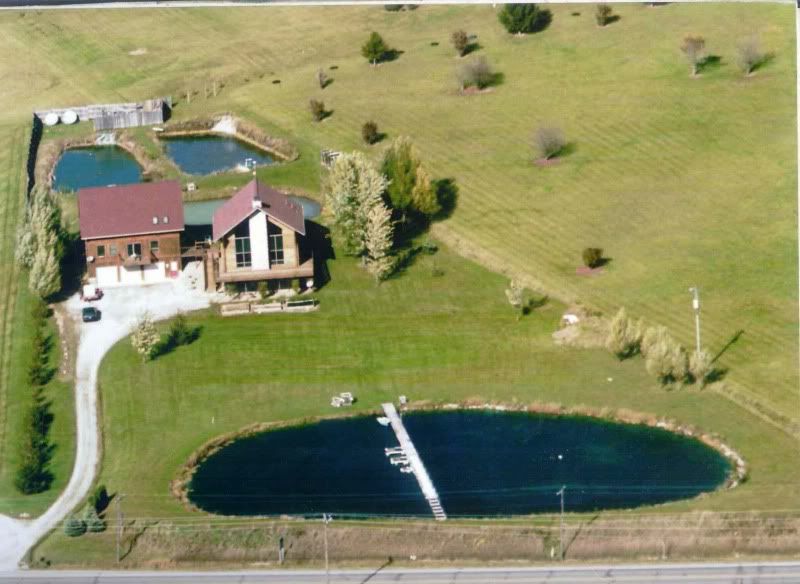
I have attached a photo of the three backyard ponds. The one in the foreground is the one I have been using for trout but the one on the left will be the trout pond from now on. The one on the right is my bluegill pond. I also have pics of my aeration set up for the well water when it first comes out of the ground if you're interested. The well and aeration is enclosed in the fencing in the back and center of the two side by side ponds. The pond in the foregroudn is the former trout pond at 88 by 59 feet. 9 foot deep max and very steep sides as in all my ponds. Pond on left that will be the new trout pond and is 90 by 40 on one end and only 22 on the other (due to property line). It's max depth is 8 feet. One on the right (bluegills) is similar in size to the one on the left but only about 7 feet max depth. Both rear ponds slope on the bottom for draining and seining if necessary.
New trout pond will run into the former trout pond (putting yellow perch into the former trout pond this spring), and then that pond will run into my much larger 200 by 150 foot bass pond at the lowest part of the property in the front as it has in the past. All flow is undergroud via 4 or 6 inch piping and I have gatevalves in ground to direct the flow if necessary.