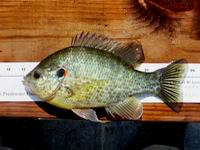
Good job Rainman. Ken I hope this helps a little.
See these.
SRAC 460 Control of Clay Turbidity in Ponds
SRAC 464 Interactions of pH, Carbon Dioxide, Alkalinity
and Hardness in Fish Ponds
http://srac.tamu.edu/index.cfm?catid=25Fish and other vertebrates have an
average blood pH of 7.4. Fish
blood comes into close contact
with water (1- or 2-cell separation)
as it passes through the blood vessels
of the gills and skin. A desirable
range for pond water pH
would be close to that of fish
blood (i.e., 7.0 to 8.0). Fish may become
stressed and die if the pH
drops below 5 (e.g., acidic runoff)
or rises above 10 (e.g., low alkalinity
combined with intense photosynthesis
by dense algal blooms �
phytoplankton or filamentous
algae).
A desirable range of
total alkalinity for fish culture is
between 75 and 200 mg/L CaCO3.
Ideally, an aquaculture pond
should have a pH between 6.5 and
9 as well as moderate to high total
alkalinity (75 to 200, but not less
than 20 mg/L) and a calcium hardness
of 100 to 250 mg/L CaCO3.
Many of the principles of chemistry
are abstract (e.g., carbonate-bicarbonate
buffering) and difficult
to grasp. However, a fundamental
understanding of the concepts and
chemistry underlying the interactions
of pH, CO2, alkalinity and
hardness is necessary for effective
and profitable pond management.
There is no way to avoid it; water
quality is water chemistry.


.gif)