Here I mined some of the data for you from Theo's SMB nesting archive and its predecessors. Wowe B'ski.
http://www.helpourfisheries.com/how_to_build_a_nest.htm Dave Willis
First, back to those KS ponds and the feed tubs with rock/gravel. I guess that I honestly wasn�t there long enough (only about 6 years) to really know if they were needed to get smallmouth bass reproduction. The biologist who told me about that �trick� is one of the best biologists I know, even to this day. He clearly said and clearly meant that the smallies would not reproduce successfully without some rock habitat and that he had to add the tubs.
Now, having said that, all of my smallmouth ponds in South Dakota have PLENTY of reproduction � in fact, nearly all of them require management to reduce smallmouth bass numbers, or they overpopulate and stunt. That includes sand and gravel pits where you would expect them to reproduce, and �hill ponds� that have very little rock. So, I honestly don�t know why those KS guys were convinced they had to add the rock baskets. Smallmouth bass must like them, as that is how our state hatchery guys get the smallies to spawn in raceways. However, do you need the rock to get them to reproduce? I don�t know for certain, and based on observations by some other folks up your direction, maybe not.
I think Brett should add the rock just for diversity of habitat. He�s obviously having fun, and diversity in habitat is good. Small, black, fingerling smallmouth bass (still less than an inch long) can be found in rocky, nearshore habitat after the male is no longer guarding the brood. They get very shallow as they try to escape predators, they are stark black and very visible, and they are easy and fun to observe in the pond. Do they need the rock? Maybe not. Do they use it if it is present? Yes! The same thing is true for adult smallmouth bass. They may not need rock, but if it is available you can bet they will be there. The rock can make great fishing attractors. I�m just brainstorming here, but why not run some rock from the shoreline down to about 6 feet depth in a few locations. Also, for an attractor for adult fish, why not make some small underwater islands or at least �humps.� I�m with Bill on making several separated patches of rock. Stack the rock deep enough (thick enough layer) so that it doesn�t disappear into soft substrate. Plus, get some height (3-d is always good for fish habitat).
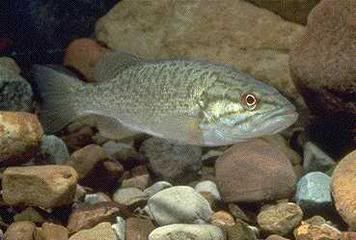
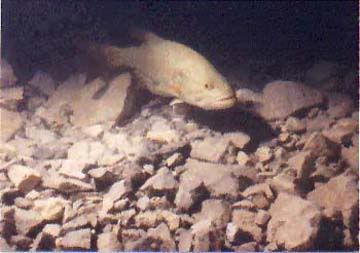
I really liked the picture of the rock you showed. The more of it that reaches basketball size, they better. I wouldn�t fool with just gravel � get some bigger rock. I like the rock in the picture because the smaller rocks and gravel may fill in nicely between the bigger rocks when you make a pile or a strip.
I am not a big fan of grass carp in many situations. However, I have stocked them into smallmouth ponds just because the vegetation is not necessary for the smallies. So, the advice on low density grass carp stockings seems good to me.
As I said, we can�t get our smallmouths to quit reproducing, with or without rock. However, I have heard other southern pond folks say that reproduction is NOT a sure thing down in the southeast. So, we may have a latitudinal or temperature thing happening here. Regardless, if Brettski is having fun with his aquascaping, and cost is not a huge concern, I�d say go for it!
ewest with comments by Bill Cody
Points from the studies below which come from the AFS symposium on Black Bass 2000.
Habitat Features Affecting Smallmouth Bass Micropterus dolomieu Nesting Success in Four Northern Wisconsin Lakes
and
Habitat Selection of Nesting Smallmouth Bass Micropterus dolomieu in Two North Temperate Lakes
Much of the info is from the same set of data collection but the first study involves more lakes. These are small Lakes � a few hundred acres. My interpretation or paraphrasing unless quotes. I will start with a few points and will add more and I hope Bill will also as he can use the edit the post function.
Rock (gravel to boulders) matters wrt nesting.
Near by wood matters also.
�Variables associated with nest protection increased the probability of predicting nest presence. Previous studies had documented and described smallmouth bass nesting in gravel and cobble substrates, and near boulders , fish cribs and other types of cover�. Wood cover, which bass use for nest protection, can increase survival of swim-up fry.�
Stay away from silt areas as they are the least likely area for selection � silt which = silt washing in on eggs does not work.
�The placement of fish cribs and large logs near coarse substrates � offered additional cover for nesting male smallmouth bass ,whereas those placed in silt and sand areas were not used�
Nests in water depths from .1m to 3m. Depth not a significant selection variable but important and may be significant in fry survival. Water clarity is important. Deeper depths are used but did not have the necessary rock cover in these lakes. ERIC, DO THE ARTICLES MENTION A VISIBILITY RANGE AS OPTIMUM? CODY NOTE - SINCE CLEAR WATER APPEARS TO BE BENEFICIAL TO FRY SURVIVAL, THE STOCKING OF CATFISH OR ANOTHER SEDIMENT ORIENTED ORGANISM (CRAYFISH OVERPOPULATION) COULD BE DETRIMENTAL BY PRODUCING MORE TURBID CONDITIONS. A FEW CATFISH STOCKED INITIALLY MAY NOT BE A PROBLEM UNLESS THEY REPRODUCE AND CAUSE CC DENSITIES TO INCREASE HIGHER THAN THOSE STOCKED. I SUSPECT OR CURENTLY THINK THAT IN MANY UNFERTILIZED PONDS WITH TRANSPARIENCIES OF 16"-28", THE CLOUDINESS IS PRIMARILY (GREATEST %) DUE TO SUSPENDED SEDIMENT AND DETRITUS AND NOT A PHYTOPLANKTON BLOOM. MORE ON THIS TOPIC LATER, HOPEFULLY IN 2007.
Distance from shore did not matter wrt selection but may well be important for fry survival. Avoid wavy near shore areas as it stirs up silt and washes eggs about.
Most likely sites selected were near shore , non silt , in water .5 to 3m, near wood ( cribs where available) and larger rocks where nest substrate consisted of gravel/rock where 40% of the particles were 6.4 to 149 mm in diameter ( .27 to 5.9 inches). In a 1m squared area . Coarse rock helped survival of eggs probably because of better O2 and less fungus.
Survival of eggs/fry was effected by habitat features. Distance to cover from nest , diameter of nearest log cover and rock size and nest position were all factors.
Will mine some more data later.
Brettski add some of that mixed rock and a few logs/boards to that crib area.
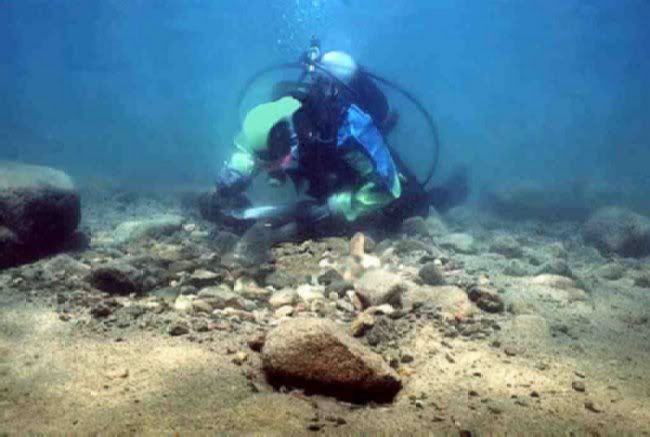
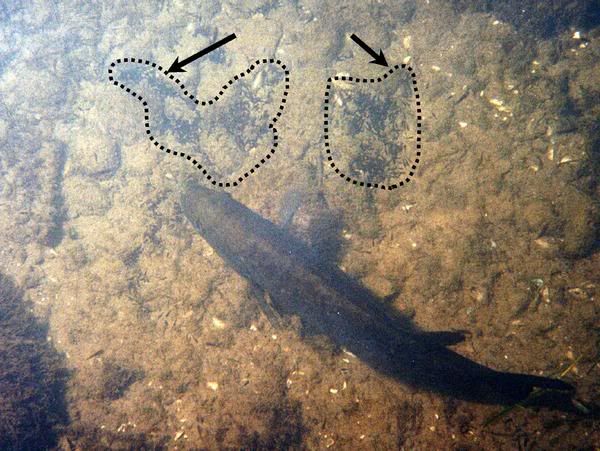
Theo's SMB beds - log added later

Here are the SMB bed areas, with root balls, on the North side

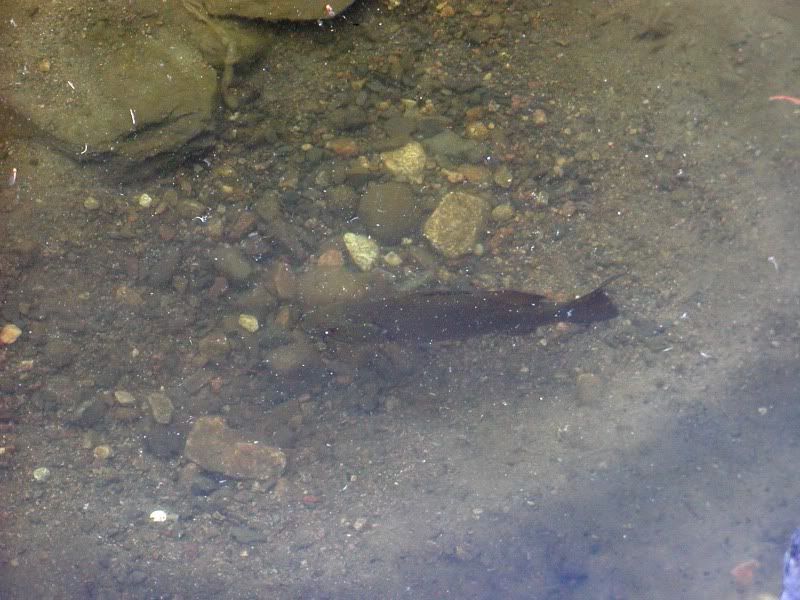
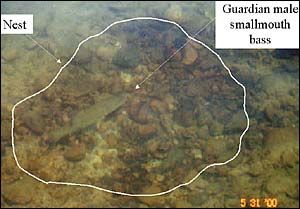
Actual SMB bedding


.gif)