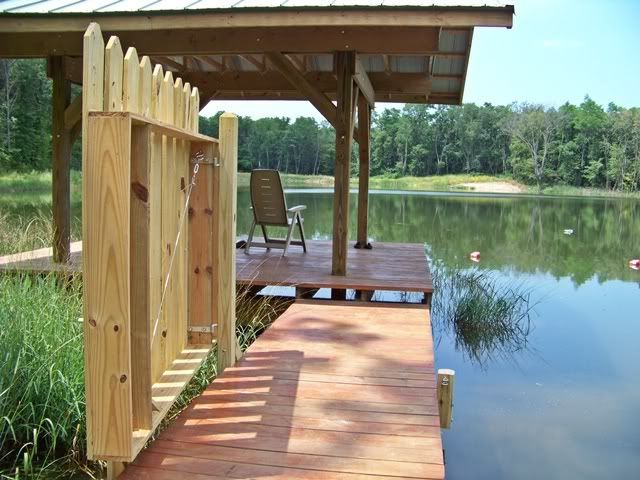
...just applied a secure, finishing touch.
-
Since I took the time to thouroughly document our little dock construction project, I would be remiss to not share one of the most important features. A gate.
The PB forum has kicked around safety and liability issues on a few different threads. In my mind, none of this pond stuff is worth a lick if you haven't taken a little time to make sure it's safe. Also, covering liability is huge. Therefore, allow me to present
The Gate post.
-
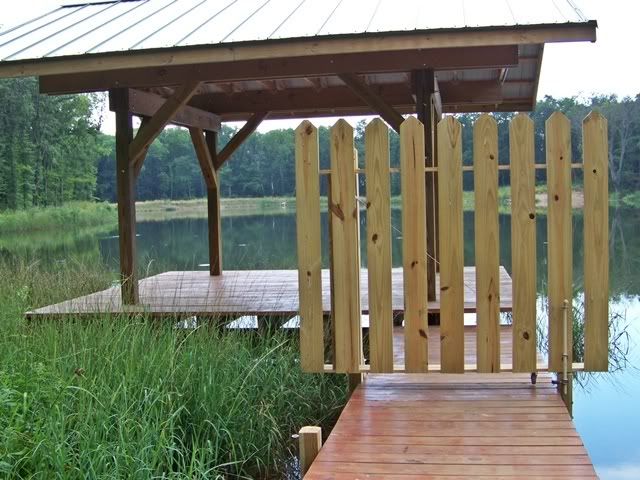
It's all treated lumber; 6 feet wide x 5 feet tall. I knew it was gonna be a heavy bugger, so I used 1-by stock wherever possible.
-
-
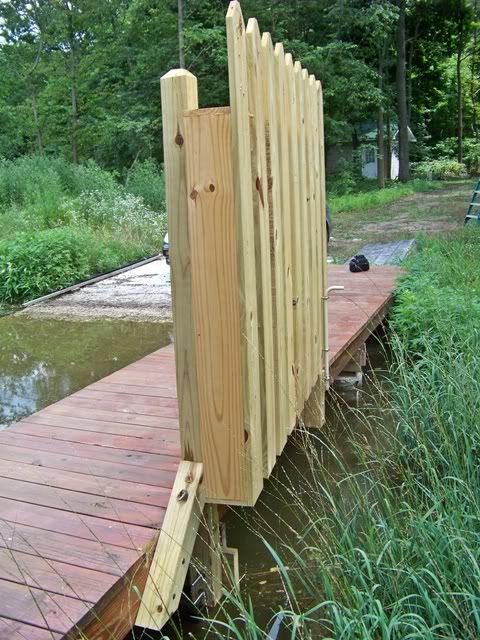
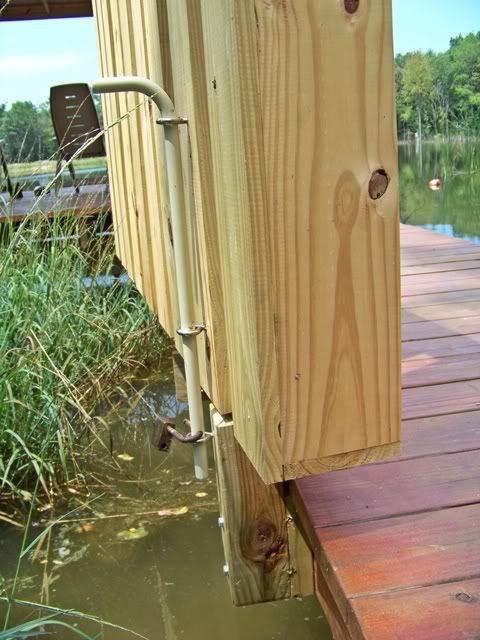
It swings on a 4 x 4 vertical post. The weight of the gate, combined with the leverage, caused me to take extra steps to beef up the attachment of this vertical post. Before we started, I removed one of the 2 x 8 horizontal support ledgers from the framing beneath the dock. I replaced it with another of the exact same, except it is about 6" longer. The additional length protrudes out and provides a good place to secure one part of the bottom of the gate post. The second place to secure was directly into the continuous decking joist. The third place is a pc of 24" long 4 x 4 with 45 degree cuts bolted to the same continuous decking joist and the gate post. Between all 3, the entire gate actually hangs and swings freely.
-
-
Even though the gate hangs OK on the gate post without additional support, I know at some point somebody is going to hang on it. I installed a rubber caster underneath the free end of the gate. It hovers about 1/2" off of the deck surface. Also, the gate has 2 specific positions: open and closed (pretty slick, eh?). I bolted short lengths of 4 x 4 to the continuous decking joists; one at each position of "open and closed" to support the free end of the gate. The tops of the 4 x 4's are chamfered to allow the gate bottom to "bump up and onto" the tops of these gate support blocks as it swings to their position.
-
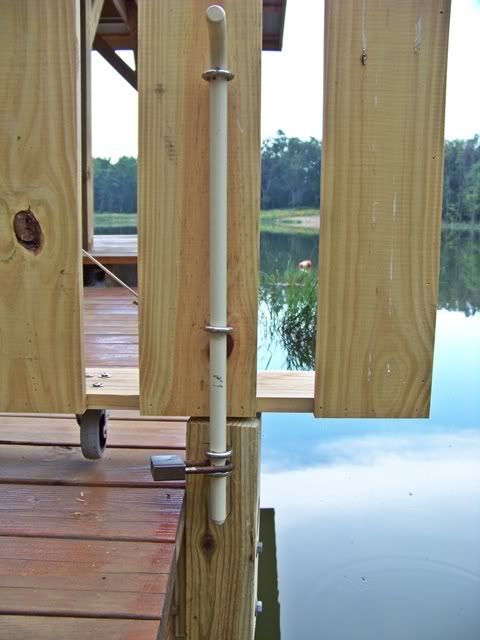
The locking rod is a pc of 3/4" round steel. I drilled a hole through the rod where the padlock slips thru. The rod guides are large stainless steel screw eyes. In the closed position, the padlock is stuck between 2 of these screw eyes so the rod cannot be moved or removed.
-
-
In the open position, another 4 x 4 support block is bolted to the continuous decking joist (identical to the block used to support the closed position). This support block only needs one screw eye to keep the gate in position. The lock just takes a ride.
-
-
C'mon in and grab a chair.