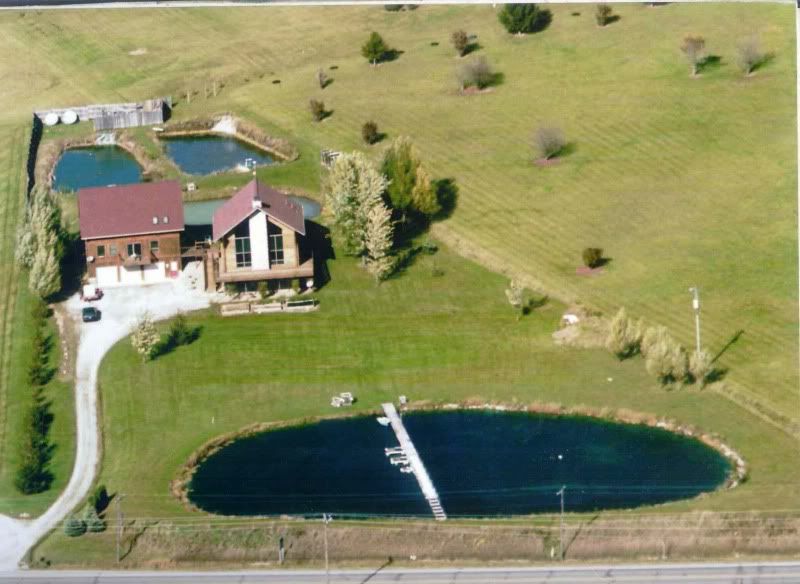
Here's an ad hoc set up for producing my own yellow perch this year that may interest some of you. I planted all of my caged male yellow perch (about 50) and 20 females into my holding pond and I'm allowing them to do their thing. I only need up to two egg ribbons for my goal, of which the ribbons will be put into the following tank until I have another pond drained and refilled ready to go.
It's taking me longer than I would like to get the perch production pond ready, and I don't want the eggs to hatch in the holding pond as there are other fish in the pond that would feed on them. And of course since it's a holding pond and needs to have fish removed soon, it's not feasible for a perch production pond. This is a last minute scramble as I was planning on getting perch from a supplier one more year, but that did not work out.
So branches of an old Christmas tree have been cut and made into bundles and attached to a piece of pipe to weight them down. I used using cable ties to attach the pipe to the branches. Here is the bundle before putting into the pond.

Here is the bundle in the pond.

If all goes as planned, a nice egg ribbon will be deposited by a female, fertilized by a male fish, and look like this from last year -- although the one in the picture is not fertilzed. (It was an all female pond)It's important that the eggs are draped on something up off the bottom for a free flow of water and oxygen. Hence the bundles.

Two fertilized egg ribbons on the bundles along with the piece of pipe to weight them down will be moved to this blue tank until I can get the pond prepared.

The tank is nothing special and left over from when I used to dump well water into it before entering the trout pond. The connection on the bottom inside the tank is not open.
Water is pumped into the tank with a little 5 gallon per minute submersible garden pump that is floated just below these jugs.

This keeps it out of the weeds and off the bottom and hopefully pulls in zooplankton for the fry if they will be in the tank that by the time they use up their egg sacks. Note the rope that is attached to the jugs and staked down in two directions to keep the pump from floating to shore.
The overflow goes out the top pipe and it's screened with a double piece of pantyhose to keep the minute fry in the tank.

Here is a better picture of the water hose that runs fresh water into the tank from the submersible pump floating under the jugs.