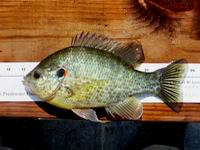
Sorry I missed this earlier Bill. More long-haired stuff - there is a bunch.
Note - The scientific name of Warmouth has been changed thus Lepomios gulosus = Chaenobryttus gulosus
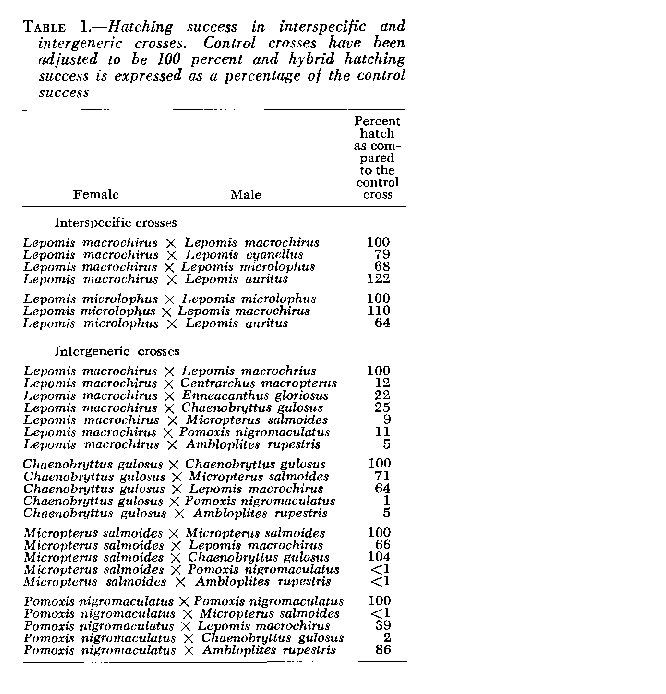
Phylogenetic Relationships of Sunfishes as
Demonstrated by Hybridization *
F. EUGENE HESTER
Via AFS
MATERIALS AND METHODS
These experiments were conducted by using
artificial stripping and fertilization techniques.
Male fish of each species were held in aquaria
in the laboratory where photoperiod and water
temperature were maintained at approximately
that existing at the time of natural spawning.
Ripe females were seined or trapped from
spawning areas and broughto the laboratory.
If necessary, they were given hormone. in-
jections of chorionic gonadotropin as. recom-
mended by Stevens (1966) to induce ovula-
tion. Eggs were stripped from a female into
several Syracuse watch glasses. Milt was
extruded by manual pressure and was col-
lected in medicine droppers. Eggs were fer-
tilized in watch glasses. Conspecific, inter-
specific and intergeneric crosses were made.
After the gameres were mixed, a small
amount of water was added. About ten
water and the watch glasses were filled with
water. Fresh water was added about three
times each day. The eggs were incubated in a
room maintained at approximately the normal
spawning temperature for the maternal parent.
Fertilization success was measured after
cleavage was obtained and hatching success
was measured after hatching was complete.
Hatching success was evaluated in relation to
hatching of the control cross by considering
the control cross success to be equal to 100%
and expressing the hybrid cross success as a
percentage of the control cross success.
Experiments were also conducted to mea-
sure the frequency and duration of partheno-
genetic development of sunfish eggs.
Twenty-three hybrid crosses (5 interspecific
and 18 intergeneric, including some recipro-
cals) were attempted, using 11 species of
fishes representing 7 genera.
West (]968) showed
that while Micropte'rus salrnoides X Chaeno-
bryttus gulosus hybrids could easily be pro-
duced and reared, they were sterile. The cross
of Chaenobryttus gulosus female X Lepornis
rnacrochirus male was more difficult to pro-
duce and rear (there were no survivors to
fingerllng size in the reciprocal cross), but
they wcrc fertile. This indicates a closer
phylogenetic relationship between Chaenobryt-
tus and Lepomis than is indicated by hatching
success (Figure 3). Chaenobryttus gulosus X
Lepornis rnacrochirus hybrids have also been
reported as naturally occurring populations
(Hubbs, 1955; Birdsong and Ycrger, 1967)
and have been artificially produced (West
and Hcster, 1966; Childers, 1967).
Another source
TEMPO OF HYBRID INVIABILITY IN CENTRARCHID FISHES
(TELEOSTEI: CENTRARCHIDAE)
DANIEL I. BOLNICK AND THOMAS J. NEAR
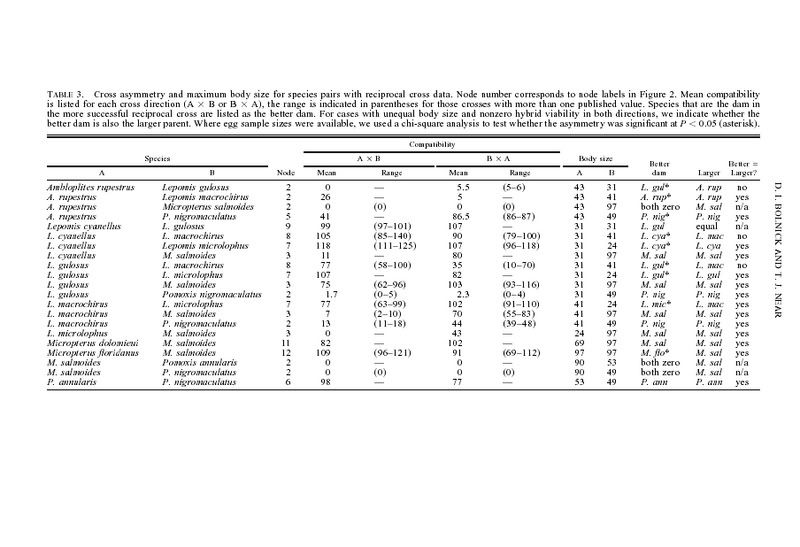
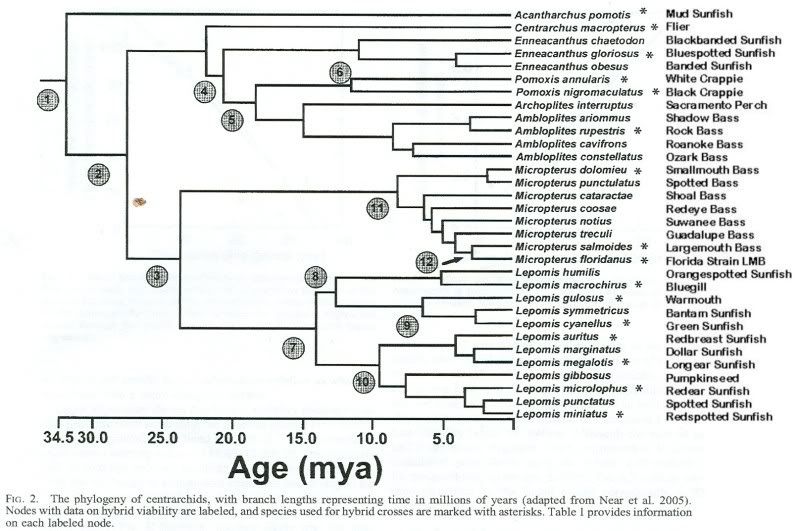
The only crosses with total inviability in
both directions are M. salmoides X (Ambloplites rupestrus,
Pomoxis annularis, or Pomoxis nigromaculatus) at 28.94 million
years, while 10 other crosses of that age have some
viability in one or both reciprocal directions (see online Appendix).
Centrarchids also retain nonzero viability and heterosis
for much longer than most other taxa.


.gif)