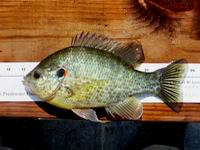
What about this Layton .
http://srac.tamu.edu/index.cfm?catid=25 SRAC 460 Control of Clay Turbidity in Ponds
Although not nearly as effective
as alum, gypsum also can be used
to control turbidity but without
the loss of alkalinity. Gypsum
must be added to achieve a concentration
of 100 to 300 mg/L for
effective turbidity control. For
most ponds, gypsum application
rates will range from about 1,000
to 2,000 pounds per acre (Fig. 4).
"In hard-water ponds (calcium
hardness greater than 50 mg/L),
the water is nearly saturated with
calcium and gypsum may be ineffective.
In that situation, alum will
be the only effective coagulant."
All the coagulants mentioned can
remove phosphorus from water.
As phosphorus is an essential
plant nutrient, it may be necessary
to fertilize the pond after treating
it for turbidity. On occasion, phytoplankton
and clay can mutually
coagulate, so fertilizing to start a
phytoplankton bloom may also
clear water of suspended clay particles.
Organic matter such as chopped
hay or cottonseed meal can reduce
clay turbidity in farm ponds.
However, large amounts of material
must be added to the pond,
which may deplete the dissolved
oxygen as the organic matter
decomposes. It may also be difficult
and costly to transport and
uniformly distribute large
amounts of organic matter.
Alum
makes water more acidic. In
ponds with low alkalinity (less
than 20 mg/L as CaCO3) it can
reduce water pH to levels that
may affect fish growth and survival.
In low alkalinity ponds, add
1/2 part hydrated lime for every
part of alum applied in order to
maintain proper pH.


.gif)