|
Forums36
Topics42,113
Posts571,674
Members19,115
| |
Most Online13,561
14 hours ago
|
|
|
|
Joined: Jun 2005
Posts: 68
Lunker
|
|
Lunker
Joined: Jun 2005
Posts: 68 |
Greetings, I just lucked into this forum while exploring pond aeration options and thought it'd be perfect to get a few opinions about a pond/lake expansion on our family�s farm. First of all our main pond has been built in 2 and a half major renovations/expansions. This will be #3 in the major category. Our farm abuts a tract of wetland (which is federally protected, we can never touch it) consisting of some 135 acres to the north of the pond site. What was a drain in a cornfield we converted into the impoundment pictured some 10-12 years ago. Anyhow, while excavating the latest expansion which backs up to the hill our house sits on we hit a shelf of shale. I've read that's bad for pond bottoms. However, I know for a fact that when we built the main pond we were into shale near the dam and we have had no problem with leakage or maintaining the water level. I suspect that possibly the water table is so high in this bottom that there is no seepage through fractures in the shale or that there is no fracture in the bed of shale at all. Also the shale in the expansion sits to the south while the fall of the watershed is to the north. Would that impact the flow of the water into or out of the pond through the shale? Now onto black crappie. I'm pretty sure I'm going to introduce them once the expansion is completed should we tie the expansion in with the main body of water. I wanted to know if anyone had any horror stories or encouragement concerning crappie. I manage the impoundment pretty strictly and it produces slab bluegill and lunker bass along with some great cats but it also has some resident species we never introduced. Some are listed as undesirable by the Kentucky Department of Fish and Wildlife including Green Sunfish and a Shiner species that looks like a 4-7 inch tarpon. The sunfish have been in there since we first dug the pond and seem to have little to no effect which is why I'm seriously contemplating the introduction of Crappie. The warnings against Green Sunfish or as we call them, warmouth, seem to be more severe than anything I've read against crappie. Looking forward to reading some responses and to contributing some of my expierence to the forum. Thanks for any thoughts in advance, KC  This is a shot of the impoundment and expansion from the base of the hill where our house rests. 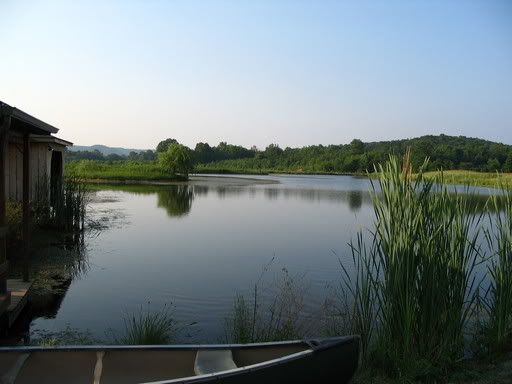 This is an image of the old impoundment looking north towards the dam. 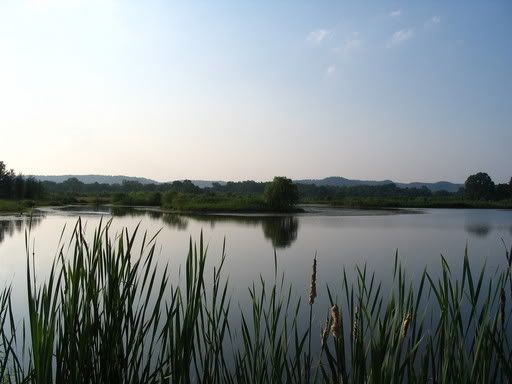 Another shot looking north.  The shale in the expansion looking south.  A screwed up wide angle image of the shelf in the new expansion.
|
|
|
|
|
Joined: Sep 2003
Posts: 14,300 Likes: 450
Moderator Ambassador Field Correspondent Hall of Fame 2014  Lunker
|
|
Moderator Ambassador Field Correspondent Hall of Fame 2014 Lunker
Joined: Sep 2003
Posts: 14,300 Likes: 450 |
K.C.,
You'll see a lot of commentary about crappie on this board.
Some of people's positions on crappie in ponds is dependent on the size of the pond. The majority general thought is that a pond needs to be very large.
What size are your ponds?
By the way, great pictures.
One sidenote, you mentioned shiners in the 4-7" range. I would think that LMB would clean those out. If there's an abundance of the shiners, it could signify an imbalance in your pond (this is pure speculation; I'm an amateur).
Welcome.
Excerpt from Robert Crais' "The Monkey's Raincoat:"
"She took another microscopic bite of her sandwich, then pushed it away. Maybe she absorbed nutrients from her surroundings."
|
|
|
|
|
Joined: Jun 2005
Posts: 68
Lunker
|
|
Lunker
Joined: Jun 2005
Posts: 68 |
Sunil thanks for the kind welcome!
I'm estimating the old pond around 7 acres. The new addition will add about an acre or two of surface area. I'm a pretty terrible judge of space. If anyone has a better eye have at it.
As for the shiners its pretty strange. I only see them in the early spring around the pump house. They eat the fish food along with the bluegills before they completely vanish for the rest of the year. Occationaly I catch a bucket of them mixed with small bluegill to take to the Ohio for the big cats. But like I said I only see them in the spring, they are gone by early to mid April. The catfish are kind of like that too in that they don't arrive up around the pump house until mid to late may and only in the last week have they appeared in significant numbers.
On another note one of the cats in the 5-6 lb range had his tail end completely skinned off. I have no idea what could have done that to him but he looked like a salmon with all that meat showing. He seems to be doing alright though, I suppose it'll grow back. Maybe a Great Blue grabbed him up in the shallows? A snapper maybe? I've never seen it before.
KC
|
|
|
|
|
Joined: Sep 2003
Posts: 14,300 Likes: 450
Moderator Ambassador Field Correspondent Hall of Fame 2014 Lunker
|
|
Moderator Ambassador Field Correspondent Hall of Fame 2014 Lunker
Joined: Sep 2003
Posts: 14,300 Likes: 450 |
K.C. your welcome. This site really is the greatest thing.
There's a search function that you can click on on the upper right (?) section of the page. You can search those topics like "crappie" and something for a pond size calculation.
When you search, it's important to select the right sub-category of the forum. ie/ if you wanted to know about putting X-mas trees in your pond, you would do your search in the "Creating Habitat" sub-category.
Anyone's guess on your pond's size in acres is going to be very rough from just the pictures.
My pond is 6-7 acres, with depths from 15' to shallow. I have black crappie in my pond. They were there when I bought the pond (6) years back.
The biggest crappie I ever caught was maybe 8-9" long. They're not overpopulated, but on the other hand, they are nothing to write home about either (I had good size LMB, bluegill, bullheads in the pond). I think my LMB population kept them in check.
So I think with your 7 acres, you could manage for a great LMB fishery (or other predator species) or a great Crappie fishery, but maybe not both. Please note I said "maybe." If you are an active pond manager, who know's what is possible.
Excerpt from Robert Crais' "The Monkey's Raincoat:"
"She took another microscopic bite of her sandwich, then pushed it away. Maybe she absorbed nutrients from her surroundings."
|
|
|
|
|
Joined: Jun 2005
Posts: 68
Lunker
|
|
Lunker
Joined: Jun 2005
Posts: 68 |
No one has any input on the shale?
|
|
|
|
|
Joined: Mar 2004
Posts: 3,075
Lunker
|
|
Lunker
Joined: Mar 2004
Posts: 3,075 |
KC,
Nice place, very nice.
I'm not personally experienced with shale, but I'd be willing to bet that in your original construction they either dug out the shale to clay or packed clay over the top of it. How deep does the vein run? From the picture it's hard to tell, but it sure appears that no way would it hold water at the base of the dam. Now, up in the area away from the dam where you are expanding maybe its less of a risk, but even there I would think the likelyhood of leaks is high. You probably aren't the only one in your area to have encountered this problem, so you might want to check with other locals.
|
|
|
|
|
Joined: Jun 2005
Posts: 68
Lunker
|
|
Lunker
Joined: Jun 2005
Posts: 68 |
Meadowlark,
Thanks for the nice words.
We built the pond ourselves. In fact I'm doing most of the work now in the evenings. Our family is in the construction business. I'm sure that we have a shale bottom near the dam. Like I said we sit in a bottom and the pond backs up to a huge wetland. I remember hitting shale when we dug the original basin and the pond actually begining to fill with water. As I stated earlier the lay of the land all falls towards the pond and wetlands, the watershed is well over 50 acres in my estimation. I suspect the vein pictured is what that hill is made of as it seems to rise right into the base. I'm hopeful that the fall of the land where the vein lies would prevent water from running backwards or uphill. Down into an aquifer is the concern I'm most anxious about but I think we may be in the water table already.
|
|
|
|
|
Joined: Mar 2004
Posts: 3,075
Lunker
|
|
Lunker
Joined: Mar 2004
Posts: 3,075 |
KC,
Is that a "dump dozer" in the picture? Never seen one of those but it looks like something I'd like to have...being an amateur pond builder myself.
|
|
|
|
|
Joined: Mar 2005
Posts: 22,033 Likes: 483
Moderator Hall of Fame 2014 Lunker
|
|
Moderator Hall of Fame 2014 Lunker
Joined: Mar 2005
Posts: 22,033 Likes: 483 |
KC :
Welcome aboard the fourm.
Shale can be impermeable {not let fluids through} and act as a seal between over or under lying strara of sands , clays or other rocks. However if it is fractured it loses its impermeability at least as to the length and depth of the fractures. If you have many interlocking fractures it is not much different than gravel. From the pics. it looks like many fractures but that could come from digging. The question is how fractured is the shale in its natural state. If solid and unfractured ( as I guess is the case in existing pond} it may not leak . Also if the shale is uniformly underlain by clay or some other sealing barrier it may not matter if fractured or not. The question of if fractured shale will leak uphill depends on the dip {angle} of the beds { not necessarly the lay of the land}. If the fractured shale bed is dipping up away from the pond then the amount of loss will depend on the water pressure at depth vs. the pressure needed to force the fluid through the fractures at depth and up dip.
If it were my call , as ML stated ,I would add clay or some other sealing material to plug the fractures. I doubt it will leak up dip to much as it apears the limited shale bed is in shallow water and you get that much elevation change quickly uphill. My worry is that it could leake through the shale bed sideways around the side of the pond and then down dip {down hill}. So you may want to pack clay around where the shale is under water and intersects the sides of the pond. That is a guess from the very limited info from your pic. I hope this helps. ewest
PS on your second question most people say that crappie because of their reproductive cycle are nor suitable in ponds under 40 acres. Much dicussion on this fourm about that.
.gif) 
|
|
|
|
|
Joined: Jun 2005
Posts: 68
Lunker
|
|
Lunker
Joined: Jun 2005
Posts: 68 |
Originally posted by Meadowlark:
KC,
Is that a "dump dozer" in the picture? Never seen one of those but it looks like something I'd like to have...being an amateur pond builder myself. It's a rubber tracked off-road truck and its ideal for these situations as it can run through sloppy muck at a depth of 3-4 feet and with 4 ft wide treads it won�t 'pump' saturated soils so you don't end up with huge ruts and a lot of clean up after you�re finished hauling. It has a large bed capacity and the tailgate is gravity released so you just go to your spot and pull the lever. We�re building a terrace off our hill with the material coming out of the pond. Anyone have any aeration tips? I was looking to buy an electric compressor and run several diffuser stones off it. How many HP should I go with and what are the best quality brands? I need to cover about 300 feet with hose so take that into consideration with any advice. Also I'm planning in mounting it in the boathouse or pumphouse so size is a consideration. Thanks in advance, KC
|
|
|
Moderated by Bill Cody, Bruce Condello, catmandoo, Chris Steelman, Dave Davidson1, esshup, ewest, FireIsHot, Omaha, Sunil, teehjaeh57 |
|







