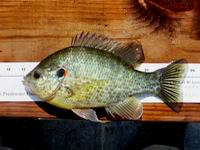
See this from PB mag Cutting Edge:
CNBG have the same sex ratio as BG (50/50).
From a prior post.
THE CUTTING EDGE � SCIENCE REVIEW
By Eric West
Coppernose Bluegill vs. Regular Bluegill � which one for you?
A question we often get on the Pond Boss Forum is should I stock Regular Bluegill Lepomis macrochirus macrochirus or Coppernose Bluegill Lepomis macrochirus mystacalis also previously classified and referred to as Lepomis m. purpurescens . To answer that question we should look at the traits of both and use the one that will work best for the particular goals for the water in question. As we all know traits come from genetics. So what is the difference in the genetics of Coppernose vs. Regular Bluegill? Well it started a long time ago and it took a long time to get there. Here is the basic story. Millions of years ago peninsular Florida was, like it is today, connected to the mainland. Bluegill were present all over the eastern US. Sea level rose and peninsular Florida was cut off by the sea from the mainland creating two separate populations. Bluegill on both the mainland and on the peninsula continued to evolve separately each influenced by local conditions with a divergence time of roughly 2.3 million years. After a few million years of this separate path sea level fell and the two land masses were connected again. However the two bluegill sub-species were now a little different genetically. The rivers were connected and the two subspecies migrated and integrated in a zone along the deep southeast where the two sub-species mixed. If this sounds familiar it should � it�s the same story as the Florida Largemouth Bass and the Northern Largemouth Bass where the divergence time between Northern (M. salmoides) and Florida (M. floridanus) bass is approximately 2.8 million years. If you know one story you should have a fairly good idea of outcome of the other. Surely as a pond owner you have heard the bass story. Florida Bass get bigger under the proper circumstance and do not due well in cold climates. Yes Bluegill have a similar story.
Coppernose Bluegill get bigger under the right circumstance but do not flourish in colder climates. In fact Coppernose are susceptible to poor results and substantial winter kill in northern US regions as are Florida Largemouth Bass. So how do you tell Coppernose and Regular Bluegill apart. Take a look at the pictures included. The Coppernose has a copper band across its head/nose in adult males, has fewer and wider vertical bars, has orangish/red fin margins and tail coloration , 12 anal fin rays and often light/white fin edges most visible when young. The Regular Bluegill has 11 anal fin rays and none of the other traits mentioned.
So how do they compare? Here are some points from a study on the subject titled Performance Comparison between Coppernose and Native Texas Bluegill Populations by John A. Prentice and J. Warren Schlechte in the 2000 Proceedings of the Annual Conference of the Southeastern Association of Fish and Wildlife Agencies , Vol. 54 at pgs 196-206 looking at growth (size at age) , survival and catchability.
Coppernose Bluegill were significantly larger than Native Bluegill in all scenarios tested with the largest observed difference being 19.2 mm total length (.756 inch) and 33.5 grams ( 1.18 ounces) over 2 years. At 3 years there was a 16 mm (.63 inch) difference on average and at 4 years 24 mm (.945 inch). With other fish species present there was no difference in angling vulnerability between the types. Spawning activity of the brooders began at the same time (last week of Feb in 1995 and first week of March in 1997) and produced the same size offspring for tagging at the same time each year ( mid-April) in what appeared to be similar numbers. Survival of young of the year Coppernose was substantially greater than for Native Bluegill.
Before you draw to many conclusions note this was in Texas where the weather is close to that of the Coppernose�s native range. That is a critical key to success with Coppernose. While there is an often cited study titled Cold Tolerance in Two Subspecies of Bluegill by , A. J. Sonski , K. E. Kulzer , and J. A. Prentice, in the 1988 Proceedings of the Annual Conference of the Southeastern Association of Fish and Wildlife Agencies , Vol. 42 at pgs 120-127 , that states Coppernose and Native Bluegill have similar cold tolerances the key is the test was done on bluegill all from the same area (Texas). Its purpose was to determine if Coppernose could survive the Texas climate. There is substantial observed and anecdotal evidence that Coppernose do not do well in cold climates (roughly north of the north line of Arkansas/Tennessee extended) . In the far northern US Coppernose become subject to high winterkill rates. This would be consistent with their similar relationship to Florida Largemouth Bass which have repeatedly been tested to do poorly and die in cold climates. The study first cited above was also in ponds with no supplemental feeding. Reported scientific evidence is substantial that in ponds the most common cause of reduced growth is a shortage of food. It is not known how much, if any, of the early growth difference between the two sub-species was due to limited forage. The two sub species will integrate (inter-breed) with the offspring exhibiting mixed traits and no apparent negatives but there is very little published data on them.
So the answer to the question should I stock Coppernose Bluegill or Regular (native) Bluegill or both is � it depends. Your location (climate) and your goals are key factors. If you are in the Deep South or the Southwest (including Southern California) and not at high elevation (Appalachian, Rocky or Sierra Mountains) Coppernose should be considered. In short is your temperature profile similar to those areas? To some extent management practices and the existing bluegill population, if any, are also possible factors. Whichever type you choose keep in mind that the most important factor to growing nice bluegill is to be sure they have enough food to eat and not to much competition.
See this link from the archives done by Bruce and the other mods.
http://forums.pondboss.com/ubbthreads.php?ubb=showflat&Number=92482#Post92482--------------------------------------------------------
Evolution
Vol. 28, No. 1, Mar., 1974
Biochemical Genetics...
Biochemical Genetics of Sunfish. I. Geographic Variation and Subspecific Intergradation in the Bluegill, Lepomis macrochirus
John C. Avise and Michael H. Smith
Evolution
Vol. 28, No. 1 (Mar., 1974), pp. 42-56
Abstract
Electrophoretic variation in proteins encoded by 15 genetic loci was analyzed in 2415 bluegill (Lepomis macrochirus) repsenting 47 populations from 7 Southern states. Populations from the Florida peninsula and southeastern Georgia (L. m. purpurescens)
{CNBG} differ in allelic composition at several loci from populations in central and western Georgia west to Texas (L. m. macrochirus)
{ regular BG}, yielding coefficients of genetic similarity below the range generally found for continuously distributed conspecific populations in other vertebrates, but quite comparable to previous reports for various semispecies pairs. Populations of L. m. purpurescens are essentially monomorphic for Es-3100 and Got-258, while populations of L. m. macrochirus are segregating for Es-396 and Es-392, and are fixed for Got-2100. Within several river drainages in South Carolina and eastern Georgia, bluegill populations are segregating for all of these alleles.
In particular, a highly significant correlation between frequencies of Got-258 and Es-3100 indicates that the two subspecies are intergrading in a wide zone of overlap. A closer examination of genotypic class proportions of a large population of bluegill from the intergrade zone confirms that the two subspecies are backcrossing and are apparently fully interfertile {able to interbreed with other species or subspecies and produce viable offspring}. Degrees of introgression appear equal for alleles at these loci. The high correlation in population allele frequencies across loci is compatable with the hypothesis that the alleles are behaving as neutral markers of intergradation. However, mildly significant deviations from expected genotypic proportions may indicate influences of selection. The pattern of intergradation evidences a secondary meeting of allopatrically evolved races. Since populations of pure L. m. purpurescens are largely confined to the Florida peninsula, it is likely that Pleistocene rises in sea level were important in their original isolation from L. m. macrochirus. Populations of bluegill within reservoirs are generally homogeneous for frequencies of common alleles at polymorphic loci. However, there is significant heterogeneity in allele frequencies between reservoirs within any drainage system. The magnitude of this variance is greatest in the intergrade populations within the Savannah River basin, and is far less in 'pure' samples of L. m. macrochirus. The bluegills examined may be characterized by three areas of relative regional uniformity, in which genetic differences within a drainage system are probably as great as those between drainage systems: 1) the Florida populations of L. m. purpurescens 2) the intergrade populations and 3) populations of L. m. macrochirus.
All Colored text my notes or edits.


.gif)