|
Forums36
Topics42,113
Posts571,674
Members19,115
| |
Most Online13,561
|
|
|
|
Joined: Oct 2013
Posts: 74
|
|
Joined: Oct 2013
Posts: 74 |
Tried to read as much as I can but sometimes it's faster just to come and ask.
I do a lot of kayak fishing rivers around here in TX and there are some lesser appreciated native species that I really like and wonder what could happen in a pond setting with these fish.
2 species in particular are spotted bass and longear sunfish.
Obviously being in the part of TX I am I'd probably have to build a pond with spawning substrate in mind for the spotted bass. But I know they "work" in their natural ecosystem as in many rivers around here they will be the most abundant black bass you catch. Granted, I don't think I could spend the money to replicate the environment they dominate in a pond setting, but I would think one could make a pond that was sustaining with spotted bass.
And for longear, my question is in a pond without bluegill, how would these guys do? Would they take to an artificial feeding program like bluegill, how would reproduction compare to bluegill in a pond absent of bluegill, and if they did take artificial feed to what sizes could you grow them?
I know this would go against the Texan way of "biggest and baddest" as I'd consider a 3 lb spot or a 3/4 lb longear to be a "success".
My "plan" for this pond would be a 1/2 to 3/4 acre pond with like 25 spotted bass from 10-12" added in late spring maybe after a spawning season of longear/RES and GSH/FHM. I admit that I haven't done a whole lot of research on longear fecundity but I would guess from fishing experience that fecundity of longear is somewhere in between RES and BG.
Not saying I would do it, but it's just a thought I had about trying to see what I could do with some underrated (IMO) species.
|
|
|
|
|
Joined: Mar 2005
Posts: 22,033 Likes: 483
Moderator Hall of Fame 2014  Lunker
|
|
Moderator Hall of Fame 2014 Lunker
Joined: Mar 2005
Posts: 22,033 Likes: 483 |
Longear Sunfish, Lepomis megalotis
Physical Description:
� Deep, very compressed body
� Black opercular spot with a pale edge
� Small, terminal mouth
� Large eye
� Tail fin lobes rounded
� Pectoral fin rounded
� Orange-brown body with blue spots and blue wavy lines on cheek
� Narrow black edge on anal fin
Similar species:
� Warmouth (Lepomis gulosus)
� Redbreast sunfish (Lepomis auritus)
Mean body size:
� Adults are 75-150 mm total length
Habitat:
� Warm ponds, reservoirs, and pools of streams and rivers
Distribution in VA:
� Tennessee and Big Sandy drainages
� Introduced to the New and Potomac drainages
Food Habits:
� Aquatic invertebrates and terrestrial insects
Reproductive Habits:
� Mature at age 2
� Spawning occurs late May to early July
� Males are territorial and build nests in colonies on gravel bottoms
� Males produce a grunting noise during courtship and spawning
� Fecundity is 2,360-22,119 eggs per female per year
� Hybridizes with many other sunfish species
Population Status, Economic, or Ecological Importance:
� Males are brightly colored
References:
Jenkins, R.E and N.M. Burkhead. 1993. Freshwater Fishes of Virginia. American Fisheries Society, Bethesda, Maryland.
.gif) 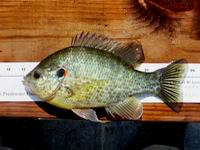
|
|
|
|
|
Joined: Dec 2006
Posts: 127
Junior Member
|
|
Junior Member
Joined: Dec 2006
Posts: 127 |
I don't know if it would work either, but I would love to have me a pond full of three pound spots.
|
|
|
Moderated by Bill Cody, Bruce Condello, catmandoo, Chris Steelman, Dave Davidson1, esshup, ewest, FireIsHot, Omaha, Sunil, teehjaeh57 |
|







