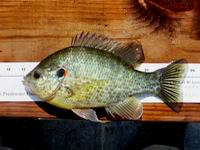
Ok guys see this - very common there is a pic at the link.
http://edis.ifas.ufl.edu/vm059 "Red Sore Disease" in Game Fish
Peggy Reed and Ruth Francis-Floyd
One of the most common disease problems encountered in freshwater game fish is generically referred to as "red sore disease." This problem usually occurs in the spring and fall, and fishermen and pond owners are often concerned by the appearance of red ulcers and sores on their fish. Typically, "red sore disease" is caused by two organisms, Aeromonas hydrophila , a bacterium, and Heteropolaria sp. (formerly Epistylis sp.), a protozoan.
Both of these organisms are found in aquatic environments and are capable of causing disease. Red sore disease will often run its course, and fish may recover without treatment. The primary concern is often not mortality of fish, but rejection of the affected fish by anglers because of the diseased appearance. Occasionally red sore disease can reach epidemic proportions, contributing to significant mortality (more than 10 percent) of game fish. When this is the case, treatment is warranted.
Identification of Red Sore Disease
Red sore disease is a generic term that describes a physical condition of fish rather than referring to a specific disease agent. Fish most frequently affected are game fish, particularly bluegill (bream), largemouth bass, and striped bass and its hybrids. The condition is observed in fish from natural waters, recreational fishing ponds, and commercial aquaculture facilities. Sores caused by Heteropolaria sp . can be characterized by white-grey, cotton-like patches on the body surface or the fins. Due to the irritation, the fish will "flash," or rub, to rid itself of the parasite, causing scale loss and ulceration of the already damaged area. This allows the bacterium Aeromonas hydrophila to enter.
In its mildest form, the condition is seen as red, raised "sores," or lesions, on the tips of fins, particularly the dorsal fin of bluegill ( Figure 1 ). As the disease progresses, fish may be afflicted with fin erosion, and ulcers on the side of their body ( Figure 1 ). Because red sore disease is a general condition rather than a specific disease, affected fish must be sent to a fish disease diagnostic laboratory in order to correctly identify the pathogens contributing to each outbreak of disease.
Figure 1.
Pathogens Contributing to Red Sore Disease
Red sore disease usually involves several aquatic organisms, most of which are considered to be "opportunists." That is, these organisms are present in the environment in which fish live, but are only able to cause disease under certain circumstances. For this reason, the condition is most prevalent in the spring and fall, when the natural disease resistance of fish is low.
One of the most important organisms that contributes to red sore disease is the stalked protozoan, Heteropolaria sp. ( Figure 2 ). This protozoan attaches to the fins, skins, or gills of fish, and forms colonies. It is capable of secreting an enzyme that begins to break down tissue at the attachment site. This damaged tissue is suitable for infestation by bacteria and/or fungi, which ultimately results in formation of a "red sore" or ulcer.
Figure 2.
The bacteria most commonly associated with red sore disease is Aeromonas hydrophila , the most common bacterial infection in aquatic organisms. Other organisms that may be associated with ulcerative lesions on fish include a number of protozoans (eg. Icthyobodo sp. [formerly Costia sp.] and Trichodina sp.), the bacterium Flexibacter columnaris and fungi in the genus Saprolegnia . The presence of a red sore does not necessarily mean that the fish has Heteropolaria sp. or Aeromonas sp.
Wet mounts of affected areas should be examined by microscope (100x and 400x) to confirm the presence of Heteropolaria sp. The colony is made up of numerous cylindrical, elongated bodies attached to the end of a branched stalk. The base of the stalk attaches itself to the skin of the fish, which it uses only as a place for attachment. There is a spiral of oral cilia, or hairs, at the end of each body, and the cilia collect bacteria and organic debris from the surrounding water.
Bacterial cultures of external lesions, as well as posterior kidney, are needed to confirm the presence of A. hydrophila or other bacteria. Primary isolation should be done using 5 percent blood agar as well as Ordal's Media for F. columnaris . Sensitivity testing should be done using Mueller-Hinton agar.
Transmission
Heteropolaria is almost everywhere in fresh water and sediments. It has a direct life cycle, requiring only the fish host. It reproduces by binary fission (dividing), and the resulting young forms are free swimming. The mature stage attaches to fish or other structures in its environment, including spawning containers and submerged logs. Heteropolaria thrives if there are high levels of organic matter in the water to provide nutrients. Stress, caused by poor water quality, crowding, water temperature variations, reduction in body condition, or spawning can increase the susceptibility of fish to red sore disease.
Treatment of "Red Sore Disease"
In many instances fish afflicted with red sore disease will recover without treatment. If lesions on most fish are mild (restricted to the tips of dorsal fins), and if few mortalities are observed, it may be advisable to observe the fish daily and elect to treat the pond only if the situation seems to worsen rather than improve.
If treatment is warranted, potassium permanganate is often effective when administered one time as a bath at 2 mg/l (see IFAS Fact Sheet #FA-23) because of its broad spectrum activity against external protozoa, bacteria, and fungi. If fish do not improve following treatment with potassium permanganate, they should be submitted to a fish disease diagnostic laboratory (see IFAS Circular #921) for a complete diagnosis.
In some instances, the disease may be far enough along that fish are dying of systemic bacterial infection secondary to external damage. Antibiotic treatments should be provided in a medicated feed based on results of bacterial isolation and sensitivity testing (see IFAS Fact Sheet #VM-70). In the event medicated feed is warranted, this medication should be administered in addition to the potassium permanganate bath. Anytime fish do not respond to treatment as expected, they should be re-evaluated by a fish diagnostic laboratory.
If fish affected with red sore disease can be handled, a 3 percent salt dip is extremely effective in eliminating external Heteropolaria sp. infections. Salt treatments are discussed in IFAS Fact Sheet #VM-86.
Wholesomeness of Fish with Red Sore Disease
Fishermen often ask whether it is safe to eat game fish that have sores on them. In most cases the sores are external only, and when the fish is cleaned, the damaged area is easily removed from edible tissue. Thorough cooking will eliminate any pathogens that might remain in tissue, resulting in a safe and wholesome product. Although the appearance of a fish with sores on it may be unappetizing, there is no reason to discard the fillets as long as they are thoroughly cleaned and cooked.
Summary
Red sore disease in game fish is common in the spring and fall, and often due to the effects of two opportunistic aquatic pathogens, Heteropolaria sp. and Aeromonas hydrophila . Heteropolaria sp. is a ciliated protozoan, found almost everywhere in fresh water. It causes problematic infestations on game fish. These protozoans flourish and attach to the skin, where they cause unsightly, bloody, ulcerated areas.
In lakes or rivers, treatment is not feasible. In recreational farm ponds or aquaculture facilities, Heteropolaria sp. may be controlled with potassium permanganate at 2 mg/l administered as a prolonged bath. A salt dip (3 percent) is also effective if it is feasible.
Aeromonas hydrophila is an aquatic bacterium capable of infecting skin or fins damaged by Heteropolaria sp. The bacterium adds to the damage caused by the protozoan, which results in formation of large red ulcers and occasionally systemic infection. If the bacterial infection becomes systemic, mortality rates will increase, and antibiotic therapy, administered in medicated feed, is warranted. Antibiotic therapy should be based on the results of sensitivity tests. Any time fish do not respond to treatment as expected, a sample should be submitted to a fish disease diagnostic laboratory for reevaluation.
Many game fish affected with red sore disease will recover without treatment. Fish heal very quickly, and sores will disappear rapidly once the recovery process has begun. Fish that have sores are still acceptable for human consumption as long as the damaged area is removed when the fish is cleaned and the meat is thoroughly cooked.
Footnotes
1.
This document is VM85, one of a series of the Veterinary Medicine-Large Animal Clinical Sciences Department, Florida Cooperative Extension Service, Institute of Food and Agricultural Sciences, University of Florida. Original publication date December 01, 1993. Reviewed September 2011. Visit the EDIS website at
http://edis.ifas.ufl.edu. 2.
Peggy Reed, biological scientist; Ruth Francis-Floyd, DVM, associate professor; College of Veterinary Medicine; Cooperative Extension Service, Institute of Food and Agricultural Sciences, University of Florida, Gainesville, 32611.
The Institute of Food and Agricultural Sciences (IFAS) is an Equal Opportunity Institution authorized to provide research, educational information and other services only to individuals and institutions that function with non-discrimination with respect to race, creed, color, religion, age, disability, sex, sexual orientation, marital status, national origin, political opinions or affiliations. For more information on obtaining other UF/IFAS Extension publications, contact your county's UF/IFAS Extension office.
U.S. Department of Agriculture, UF/IFAS Extension Service, University of Florida, IFAS, Florida A & M University Cooperative Extension Program, and Boards of County Commissioners Cooperating. Nick T. Place, dean for UF/IFAS Extension.


.gif)