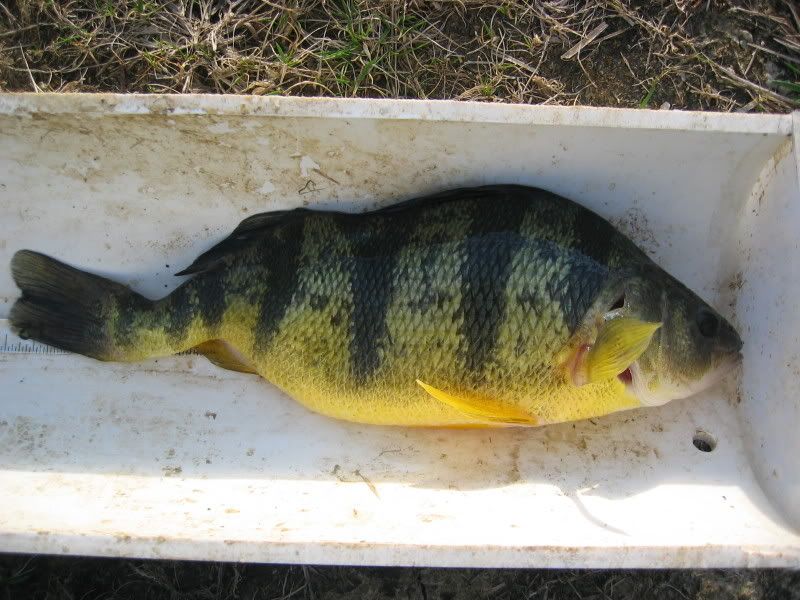
Scoliosis or lardosis of which I get the two confused. Caused by something that happened to it as a fry as in Vitamin C deficiency if it was pellet fed (due to old feed), some type of bacterial or viral infection or just genetic. At least according to fish health text I have. I see three or four fish with this condition in my yellow perch I produce every year.
If pigs could fly bacon would be harder to come by and there would be a lot of damaged trees.
It looks like a broken/injured back. That can happen in electrofishing. It does not kill the fish just results in the injury on occasion. If only a few fish are that way I doubt it is genetics as that would exhibit differently IMO.
If only a few fish are that way I doubt it is genetics as that would exhibit differently IMO.
Eric,
I respectfully disagree. While it could have been from electrofishing it being only a few fish does not mean one can rule out genetics. I would actually think it would be more if it was electrofishing and the electric level was set too intense.
Here are some pics of fish from my ponds that exhibit the same thing or something similar. Some electrofishing was done here years ago but not while the following fish were in the ponds. I see this on a handful of the perch I produce each year and my original supplier does too.
One fish in this cooler exhibits scoliosis a lateral bend in the spinal column.
Here's another one that exhibits lardosis a vertical bend in the spinal column.
I have several pics somewhere of YOY perch that have these issues. I get a handful every year and discard them.
A genetic abnormality I observed in some of my feed trained largemouth bass probably due to inbreeding:
The bottom jaw comes to a triangular point.
Many suppliers keep breeding the same stock over and over again without bringing in new stock. Many don't use the minimum number of broodstock either.
Up here in the Great Lakes they're afraid of bringing in new fish especially from the wild due to VHS concerns. Even though wild fish up here have apparently developed an immunity they can still test positive for VHS. Bringing in those fish for broodstock, could cause some health issues in the farm fish that have not been exposed. Worst of all a fish farm does not want to test positive for VHS. It would be the first fish farm that does so and an absolute nightmare for the business.
Last edited by Cecil Baird1; 04/10/1310:23 AM.
If pigs could fly bacon would be harder to come by and there would be a lot of damaged trees.
Doubt CGF has YP or high pellet feeding levels. Only recently started seeing the condition unlike you (every year). He started seeing this after electrofishing started. Could be a dietary condition but IMO much more likely they are electrofish related. Possibly injured as small fish. Note I never said it was not dietary but only that I don't think its genetics.
You're right Eric you didn't. I corrected that in my post. Just saying there are other possibilities besides electrofishing -- especially genetic -- although this could very well be electrofishing in his case.
BTW the artificial feed is an issue with low Vitamin C when the fish is in early development.
Last edited by Cecil Baird1; 04/10/1310:15 AM.
If pigs could fly bacon would be harder to come by and there would be a lot of damaged trees.
Yes it could be any of several reasons. Good to point them all out. I like the pics you added above. He needs to look further into possibilities and causes. More info on stocking times and species , lake size , mgt efforts and timing would help us narrow the possibilities. Also could send off a fish or two to AU for diagnosis if warranted.
I don't think we know all the possible deficiencies resulting from high levels of pelleted feed for long periods. Vit C yes , others possibly. That is why on carnivorous fish (LMB , YP , HSB , BG and others) I want fish meal/oil as it most closely resembles (amino acids/proteins) their natural diet. There is a lot unknown about fish diets/nutrition and its effects. Having said that however pellets beat the heck out of having starving fish.
Agreed. I was not dissing pelleted feed though. Just making the point that in some cases there can be vitamin deficencies especially if the feed is stored too long.
Some aren't aware that over time a bag of feed looses it's vitamins if stored too long. Vitamin C is the first to go. I know some manufacturers of pellet feed use something called "Stay C" to keep Vitamin C intact longer. However I've also seen fish producers stockpile feed over long periods of time for a year or more.
Last edited by Cecil Baird1; 04/10/1310:38 AM.
If pigs could fly bacon would be harder to come by and there would be a lot of damaged trees.
At that time forum member CJBS2003 suggested adding new bass to the population at some time to introduce new genes due to the age of the lake.
Anyway I showed the picture to the biologist we use and he did not seem too concerned. I will have another electrofishing sample early / mid May and will ask him about it again and about adding "new bass".
Our hatchery produce a high percentage of LMB that display a very similar defect. Mr. Lusk personally observed them and suspected either a nutritional deficiency or genetic problem, such as inbreeding since no new/different genetics have been introduced since the lake was build in 1896.
Excerpt from Robert Crais' "The Monkey's Raincoat:" "She took another microscopic bite of her sandwich, then pushed it away. Maybe she absorbed nutrients from her surroundings."
That is as old as dirt - no doubt that you need some more than 1896 genes in a pond that small and that old.
The resevoir is 350 acres of surface water, but still small by mainland standards I suppose. We're having trouble finding a hatchery willing to ship feed trained fingerlings way out here. Sorry for the small threadjack.
Most manufacturers say don't buy more than 3 months out but I think a Aquamax rep at one of the conventions told me a few years ago their feed holds Vitamin C up to a year. Perhaps someone that has a contact with Aquamax can chime in?
Like I said earlier in the thread these spinal deformities, if they are feed related, vs. genetics or eletroshocking, take place in the formative period of a fry's life. Not later on. That said deficiencies in vitamins and minerals can cause other problems anytime in a fish's lifetime.
If pigs could fly bacon would be harder to come by and there would be a lot of damaged trees.
From the PB Conv talk on Supp Feeding I did. Note the last point.
Basic Food Components � Nutrition
� The immense variety of cultured finfish species hampers efforts to simplify production industry wide. Approximately 170 taxa are currently cultured, including carnivores, herbivores, planktivores, and omnivores, each posing its own set of nutritional demands .
� Fish meal has proven to be an excellent dietary protein source for finfish, leading to its description as an ��ideal protein.�� The ideal protein concept is based on the premise that if the amino acid profile of the feed mimics the whole-body amino acid profile of the animal being fed, protein utilization and growth should be maximized
� Lipids, fatty acids, and their derivatives play a role in virtually every physiological process that occurs and for this reason dietary lipid composition and content represent a massive sector of overall nutrition. Nowhere is this more true than in finfish nutrition where lipid can exceed protein in the body composition of finfish, a testament to the physiological and energetic importance of this nutrient class (Tocher2003). Aside from physiological importance, lipids are indispensable energy sources, especially for finfish, which are not well-adapted to carbohydrate utilization.
� Dietary protein and energy must be kept in proper balance because a deficiency or excess of dietary energy can reduce growth rates. Fish fed diets deficient in energy will metabolize more expensive dietary protein to meet energy requirements. Excess dietary energy can decrease protein intake and suppress growth.
� finfish do not require carbohydrates in their diet, � complex carbohydrates cannot be digested and utilized efficiently by most finfish species. A general dichotomy exists in the carbohydrate digestive ability of warmwater omnivores and herbivores versus the inability of coolwater and coldwater carnivores, which lack the appropriate function necessary for digestion of carbohydrates.
� For this reason, diets fed to these fish rarely contain more than 20% complex carbohydrate
� Conversely, warmwater omnivores or herbivores (e.g., channel catfish, tilapia, common carp, and white sturgeon) adapt well to diets containing as much as 40% dietary carbohydrate .
� Although vitamins and minerals are required in minute amounts compared with protein, lipid, and so forth, they are critically important, � Every micronutrient has a deficiency disease associated with it, the effects of which are sometimes irreversible or fatal. For a few vitamins and most minerals, excess can be equally detrimental, resulting in toxicity.


.gif)